
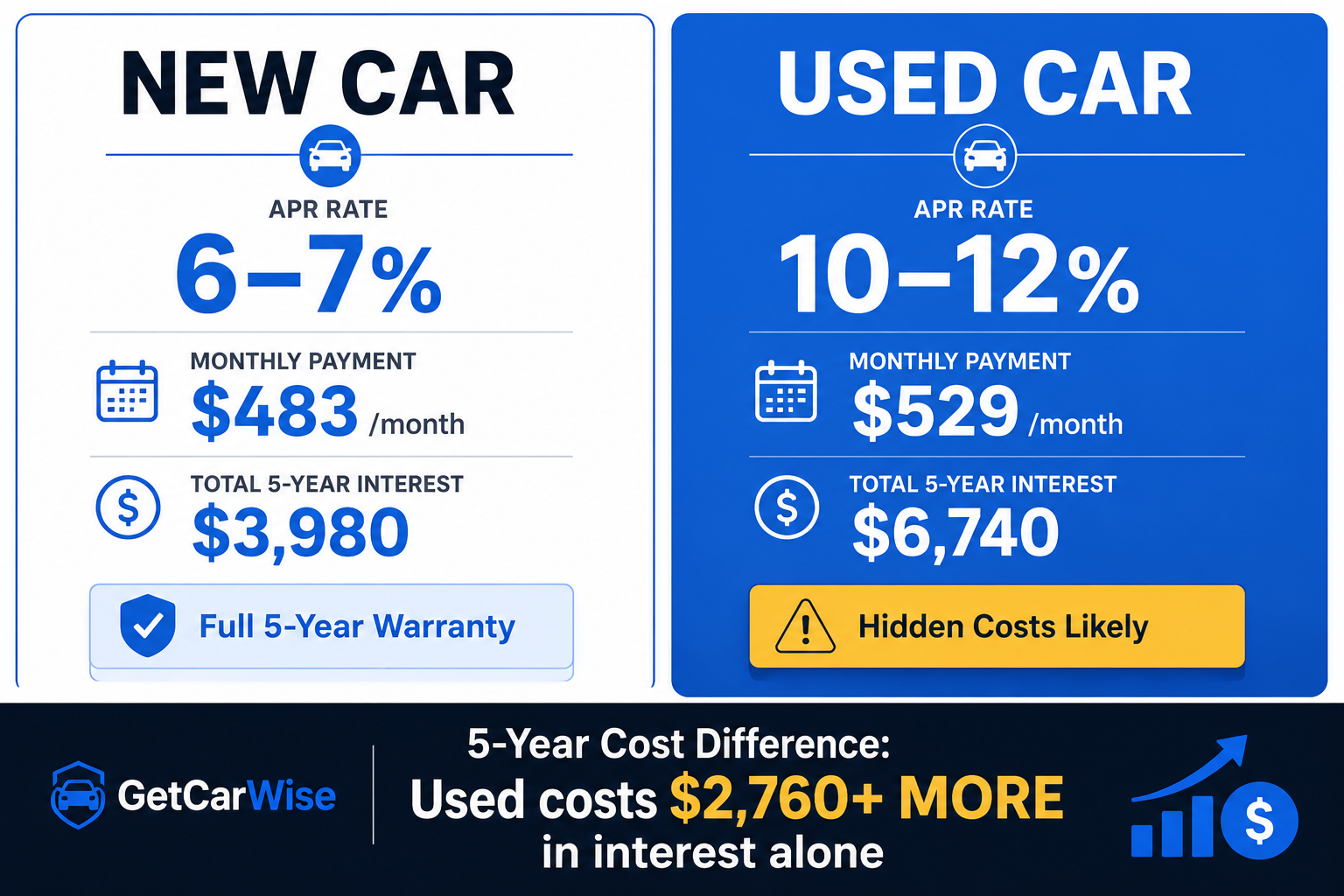
The APR Inversion: Used car loans now cost 10–12% APR, while new cars run 6–7%. This flips the math entirely.
Cross-Shopping Works: 66% of buyers now compare new and used simultaneously — and often find new is cheaper over 5 years.
The Hidden Cost: Used car buyers pay $2,000–$5,000 more in unexpected fees, repairs, and warranty gaps.
The Solution: Calculate total cost of ownership (TCO) side-by-side. New often wins when you factor in warranty and reliability.
Why the “Buy Used” Advice Is Broken
For decades, financial advisors handed out the same tired guidance: “Buy a 2–3 year old used car and save thousands.” That advice made sense in 2015. Today, it’s dangerously outdated.
The automotive market has fundamentally shifted. Used car prices remain artificially inflated, stuck at levels 15–20% above pre-pandemic levels. Meanwhile, interest rates have inverted in a way that punishes used car buyers specifically. The result: many buyers are now paying *more* by going used than they would by buying new.
This isn’t theory. This is the lived experience of 66% of car shoppers today, who now actively cross-shop new and used vehicles simultaneously. And for good reason.
The APR Inversion: Why Used Car Loans Now Cost More
The math is stark. Used car loan rates are currently averaging 10–12% APR. New car loans? 6–7% APR. Some manufacturers offer promotional rates as low as 2–4%.
On a $25,000 loan, this difference matters enormously:
- Used car at 11% APR (60 months): $529/month, total interest paid $6,740
- New car at 6% APR (60 months): $483/month, total interest paid $3,980
- Monthly difference: $46 more for used
- 5-year difference: $2,760 more in interest paid on the used car
Now add depreciation. A new $28,000 car depreciates roughly 20% in the first year, but then stabilizes. A 3-year-old $25,000 used car, by contrast, continues depreciating at 10–15% annually until it hits the 8–10 year mark.
The crossover point is real: for many buyers, the monthly payment + interest + depreciation math now favors new.
The Hidden Costs of Used Cars
The sticker price isn’t the full story. Used car buyers face a gauntlet of hidden costs that new car buyers simply don’t encounter:
Unexpected Repairs and Maintenance
A used car at 40,000–80,000 miles is no longer under factory warranty. When the transmission starts slipping, the suspension creaks, or the fuel pump dies, that’s on you. A single major repair can cost $1,500–$3,000. New cars come with 3–5 year warranties that cover most mechanical failures.
Junk Fees and Hidden Dealer Costs
Used car dealerships are notorious for buried fees. Documentation charges ($200–$500), dealer prep ($500–$1,500), “market adjustment” premiums ($1,000–$5,000 in hot markets), and extended warranty upsells ($1,500–$3,000). A $20,000 used car can easily become a $24,000 out-the-door bill.
Residual Value and Depreciation Uncertainty
A used car’s resale value is uncertain. If you buy a 2022 model and sell it in 3 years, its value depends on market conditions, mileage, and condition reports that are hard to predict. New cars, by contrast, have more stable residual values because manufacturer incentives are more predictable.
No Warranty Coverage for Repairs
Most used cars are sold “as-is” or with a limited 30–90 day powertrain warranty. Compare this to a new car’s 5–10 year/100,000 mile comprehensive warranty. That warranty translates to peace of mind and zero out-of-pocket repair costs for most common failures.
When New Actually Wins: Three Real Scenarios
Scenario 1: The Corolla Cross-Shop
You’re looking for a reliable compact sedan. Option A: a 2021 Toyota Corolla with 65,000 miles, priced at $18,500. Option B: a new 2026 Toyota Corolla, priced at $22,000.
At first glance, the used car saves $3,500. But let’s calculate 5-year total cost of ownership:
- Used 2021 Corolla: $18,500 + $12,000 (11% APR interest) + $2,500 (repairs/maintenance outside warranty) + $1,000 (unexpected dealer fees) = $34,000
- New 2026 Corolla: $22,000 + $7,200 (6% APR interest) + $200 (routine maintenance only) + $0 (comprehensive warranty) = $29,400
The new car costs $4,600 *less* over 5 years, despite the higher sticker price.
Scenario 2: The Civic vs. Used Market Chaos
A 2023 Honda Civic (used) is selling for $19,000 with 45,000 miles. A brand new 2026 Civic costs $24,500. But here’s the problem: the used 2023 is coming off warranty in 2 years. Any major repair after that is out of pocket. The new 2026 has a 5-year bumper-to-bumper warranty.
If that used Civic needs a transmission bearing replacement at 85,000 miles (common on some years), you’re paying $1,800 out of pocket. The new Civic would be covered.
Scenario 3: The Zero-Percent APR Deal
Some manufacturers offer 0% APR on select new models (usually inventory clearing). A $26,000 new car at 0% APR is now *vastly* cheaper than a $22,000 used car at 11% APR. The used car buyer pays $13,200 in interest over 60 months. The new car buyer pays $0.
In this case, new wins decisively, despite the higher sticker price.
How to Cross-Shop Effectively
The key is calculating total cost of ownership, not just the monthly payment. Here’s the framework:
Step 1: Gather the Data
- Sticker price (new or used)
- Down payment you can afford
- Interest rate for that vehicle type (check your bank or credit union)
- Loan term (typically 60 months)
- Expected mileage over 5 years (typically 12,000–15,000 miles/year)
Step 2: Calculate Total Interest
Use a loan calculator (or ask your AI copilot) to find total interest paid. This is where the APR inversion becomes visible.
Step 3: Estimate Maintenance and Repairs
- New cars: Budget $0–$500/year (warranty covers most). Factor in tire replacement only.
- Used cars: Budget $1,500–$2,500/year. Assume at least one major repair.
Step 4: Check Warranty Coverage
What does the warranty cover? For used cars, verify the coverage period. Many “certified pre-owned” warranties are limited and don’t cover wear items.
Step 5: Calculate Residual Value
What will the car be worth in 5 years? Use resources like KBB or Edmunds. Subtract this from your total cost to find your *true* cost of ownership.
The Bottom Line: Cross-Shopping Saves Money
The old advice to “always buy used” was based on a different financial landscape. Today, when used car APRs are 4–6 percentage points higher than new car rates, and when used cars carry hidden repair costs and warranty gaps, the math has fundamentally changed.
66% of buyers now cross-shop new and used for a reason. They’re discovering that new is often cheaper when you factor in the full picture.
The key is to calculate total cost of ownership side-by-side, not just the monthly payment. When you do, you’ll often find that the “expensive” new car is actually the smarter financial choice.
Ready to run the numbers on your next car? Our CarClever Lite tool calculates total cost of ownership instantly, comparing new vs. used options so you can see which actually costs less.
Leave a Reply