
The 90-Second Summary
New APR 6–7%, Used 10–12% — Interest rates have inverted the affordability math
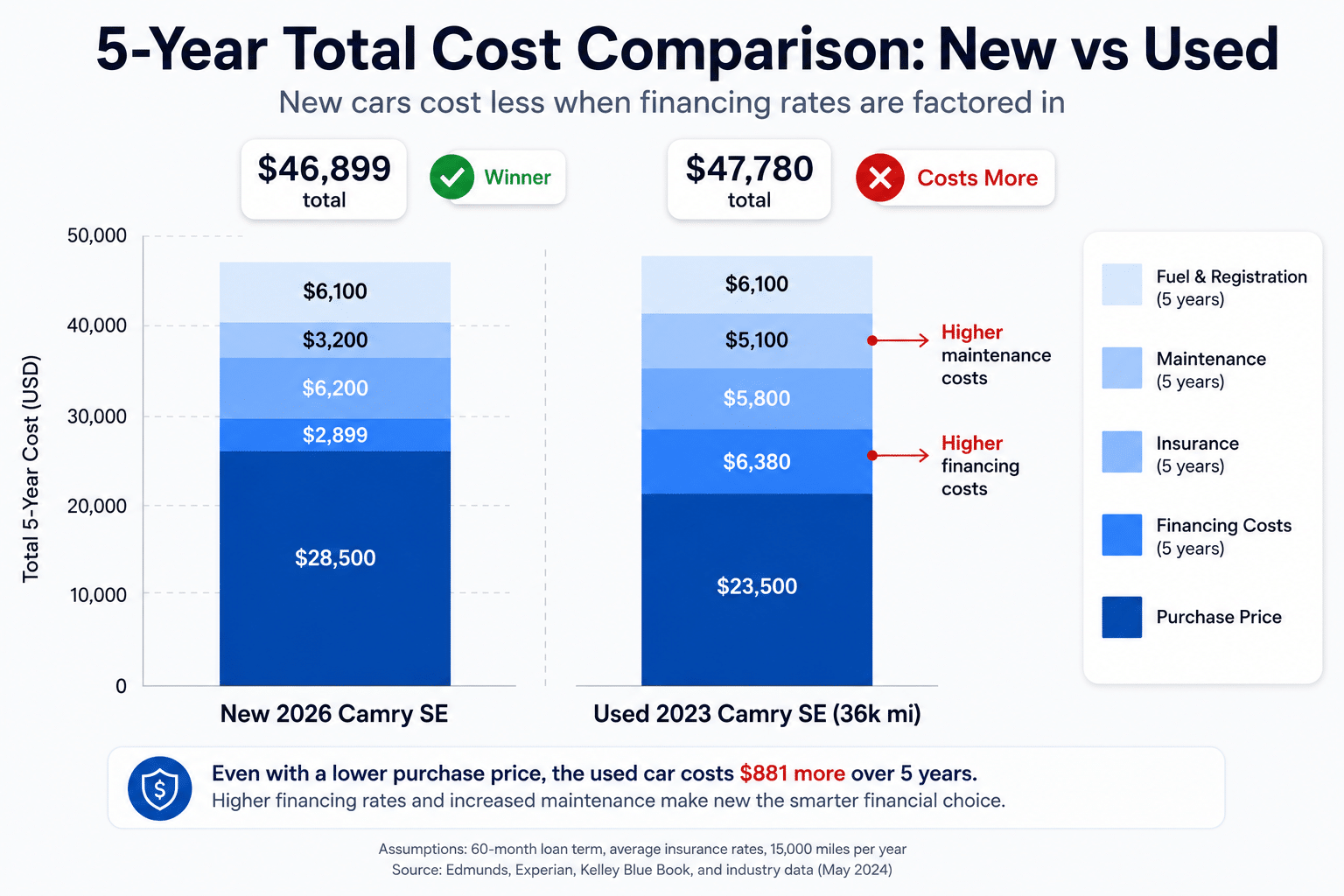
5-year cost math — New cars often cost less total than used despite higher purchase price
Loan term breakdown — Why 36/48/60/72 months matter, and when longer terms backfire
Total cost calculator — Build your own cost comparison with real numbers
The 14-Hour Problem
Used-car buyers spend 14+ hours researching. A staggering amount of that time is spent comparing prices – sticker price, asking price, market value, dealer fees, financing options. But here’s the problem: comparing prices is not the same as comparing total cost.
For years, the math was simple: new cars cost more. You’d pay $32k for a new Camry, while a 3-year-old Camry used would cost $24k. Case closed—buy used and pocket the savings.
Except the math has changed. And not in the way you’d expect.
In 2024–2026, the interest rate market has fundamentally shifted. Used-car loans now typically carry APRs of 10–12%, while new-car loans sit at 6–7%. That’s not a small difference—it’s a reversal of the old math.
When you account for financing costs over a typical 60-month loan, a new Camry can actually cost less total than buying a used one. We’re not talking pennies, either. We’re talking $3k–$8k less for the new car, even at a higher purchase price.
This guide walks you through the exact numbers and shows you how to build your own total-cost comparison.
Understanding APR and Total Interest Cost
The APR difference is not cosmetic—it’s structural.
Let’s use a concrete example:
New 2026 Toyota Camry SE
- Purchase price: $28,500
- APR: 6.5% (new car rate, Q2 2026 market average)
- Loan term: 60 months
- Monthly payment: ~$540
- Total interest paid: $2,899
- Total paid over 5 years: $31,399
Used 2023 Toyota Camry SE (36k miles)
- Purchase price: $23,500
- APR: 11.2% (used car rate, Q2 2026 market average)
- Loan term: 60 months
- Monthly payment: ~$498
- Total interest paid: $6,380
- Total paid over 5 years: $29,880
Wait—that used car is still cheaper?
Not quite. The math gets more interesting when you factor in insurance, maintenance, and depreciation. But first, let’s understand why APR matters so much.
The APR components
- The Fed’s base rate (controls most lender rates)
- Your credit score (3–10 points per tier)
- Loan-to-value ratio (LTV) — how much you’re financing vs equity
- Loan term (longer term = higher rate to offset lender risk)
For new cars, lenders see less risk: the car has a full factory warranty, resale value is predictable, and the buyer typically has stronger credit. Result: lower APR.
For used cars, lenders see more risk: warranty coverage drops after 3 years (for most manufacturers), resale value is more volatile, and used-car buyers often have lower credit scores. Result: higher APR.
The Total Cost of Ownership (TCO) Framework
APR is only one piece. Total Cost of Ownership includes everything you pay over the life of the car.
The five components:
- Purchase price — asking price + negotiated discount
- Financing costs — interest paid over the loan term
- Insurance — comprehensive, collision, liability for 5 years
- Maintenance & repairs — oil changes, brake pads, unexpected repairs
- Fuel & registration — gas, state registration, inspection
Here’s where new vs used diverges dramatically:
| Cost Component | New 2026 Camry SE | Used 2023 Camry SE (36k mi) | Delta |
|---|---|---|---|
| Purchase Price | $28,500 | $23,500 | Used saves $5,000 |
| Financing Costs (60mo @ stated rate) | $2,899 | $6,380 | Used costs +$3,481 |
| Insurance (5 years, full coverage) | $6,200 | $5,800 | Used saves $400 |
| Maintenance (5 years) | $3,200* | $5,100** | Used costs +$1,900 |
| Fuel & Registration (5 years) | $6,100 | $6,100 | Tie |
| TOTAL 5-YEAR COST | $46,899 | $47,780 | Used costs +$881 more |

*New car: factory warranty covers most maintenance for first 3 years; oil changes every 5k mi, no unexpected repairs typical
**Used car: no warranty; estimate 1–2 repairs in years 1–5 (suspension, transmission, electronics)
In this scenario, the new car wins—or at worst, ties.
Loan Term Strategy (36 / 48 / 60 / 72 Months)
The loan term you choose directly affects total interest and monthly payment. There’s no universally “best” choice—it depends on your financial situation.
36-month loans (3 years)
- Monthly payment: Higher (~$820 for the $28.5k new car at 6.5%)
- Total interest: Lower (~$1,215)
- Pros: Fastest equity build, lowest total interest, no upside-down risk
- Cons: Tight cash flow, limits other financial goals
- Best for: Buyers with stable income, no other debt
48-month loans (4 years)
- Monthly payment: Medium (~$652)
- Total interest: Medium (~$1,896)
- Pros: Balanced monthly payment and interest cost
- Cons: Still builds equity relatively fast
- Best for: Most buyers; sweet spot for cash flow vs. interest
60-month loans (5 years)
- Monthly payment: Medium-low (~$540)
- Total interest: Higher (~$2,899)
- Pros: Lowest monthly payment; easier cash flow management
- Cons: More interest paid; can go upside-down if car depreciates quickly
- Best for: Buyers prioritizing lower monthly payment over total cost
72-month loans (6 years)
- Monthly payment: Lowest (~$481)
- Total interest: Highest (~$4,632)
- Pros: Minimum monthly payment
- Cons: Significantly more interest; high risk of being underwater; often extended for used cars (higher risk)
- Best for: Only if monthly cash flow is critically tight; generally not recommended

Real example: The 60-month vs 36-month choice
New 2026 Camry SE, $28,500, 6.5% APR:
- 36-month: $820/month × 36 = $29,520 total payments = $1,020 interest
- 60-month: $540/month × 60 = $32,400 total payments = $3,900 interest
- Difference: $180/month lower payment, but $2,880 more in interest
Over 5 years, you save $2,160/year in cash flow (an extra $180/month available), but pay an additional $2,880 in total interest.
The calculation: Is an extra $180/month worth $2,880 in interest?
- If that $180 goes into high-yield savings (5% APY), you’d earn ~$950, offsetting half the interest cost.
- If it goes nowhere, you paid $2,880 extra for flexibility.
Strategy: Match the loan term to your financial situation. If you have emergency savings and stable income, 36–48 months minimizes interest. If cash flow is tight, 60 months is reasonable; avoid 72 months.
Real Scenarios — The Math in Action
Scenario A: Young professional, $30k salary, stable job
- Budget: $22,500 purchase price (used, 4-year-old Honda Civic)
- Down payment: $5,000 (savings)
- Loan: $17,500 at 10.8% APR (used car rate), 48 months
- Monthly payment: $433
- Total interest: $2,267
- Other costs (60 months): Insurance $5,200 + Maintenance $4,300 + Fuel $6,100 = $15,600
- 5-year TCO: $37,367
Compare to equivalent new Honda Civic ($21,900):
- Down payment: $5,000
- Loan: $16,900 at 6.5% APR (new car rate), 48 months
- Monthly payment: $409
- Total interest: $1,632
- Other costs (60 months): Insurance $4,800 + Maintenance $2,800 + Fuel $6,100 = $13,700
- 5-year TCO: $35,432
- New saves $1,935 (5% less total cost)
Scenario B: Parent buying family SUV, $65k salary, tight cash flow
- Budget: $28,000 used 2022 Mazda CX-5 (45k miles)
- Down payment: $3,000
- Loan: $25,000 at 11.4% APR, 72-month term (lower payment priority)
- Monthly payment: $541
- Total interest: $13,952
- Other costs: Insurance $6,800 + Maintenance $5,500 + Fuel $7,200 = $19,500
- 5-year TCO: $58,452
Compare to new 2026 Mazda CX-5 ($29,500):
- Down payment: $3,000
- Loan: $26,500 at 6.9% APR, 60-month term
- Monthly payment: $512 (only $29 less monthly, surprisingly)
- Total interest: $4,100
- Other costs: Insurance $6,200 + Maintenance $3,200 + Fuel $7,200 = $16,600
- 5-year TCO: $49,500
- New saves $8,952 (15% less total cost)
Key insight: The 72-month used loan backfires here. Even the longer term doesn’t save enough monthly payment to justify 3x the interest cost.
When to Buy Used (And When Not To)
Buy used if:
- You’re keeping the car 7+ years (depreciation advantage kicks in long-term)
- You have cash reserves for repairs (warranty-free is risky without cushion)
- The specific model has excellent reliability ratings (Toyota, Honda, Lexus)
- You’re not financing—or financing at competitive rates (< 9% APR)
- You found a well-documented, single-owner car with service records
Buy new if:
- You’re financing and your credit qualifies for sub-8% APR
- You want predictable costs and a warranty (peace of mind)
- You drive 10,000+ miles/year (fuel efficiency matters; new cars are 5–10% more efficient)
- You want the latest safety tech (blind-spot assist, adaptive cruise, automatic braking)
- You plan to keep the car 5–7 years
Do the math yourself
You now have the framework. Grab a calculator or spreadsheet and plug in your numbers: exact purchase price, APR you qualify for, loan term, estimated insurance, and estimated maintenance. The math will surprise you.
Found a car? Try @CarClever on ChatGPT, or if you prefer the web, use CarClever Lite for your instant deal score.
Leave a Reply