
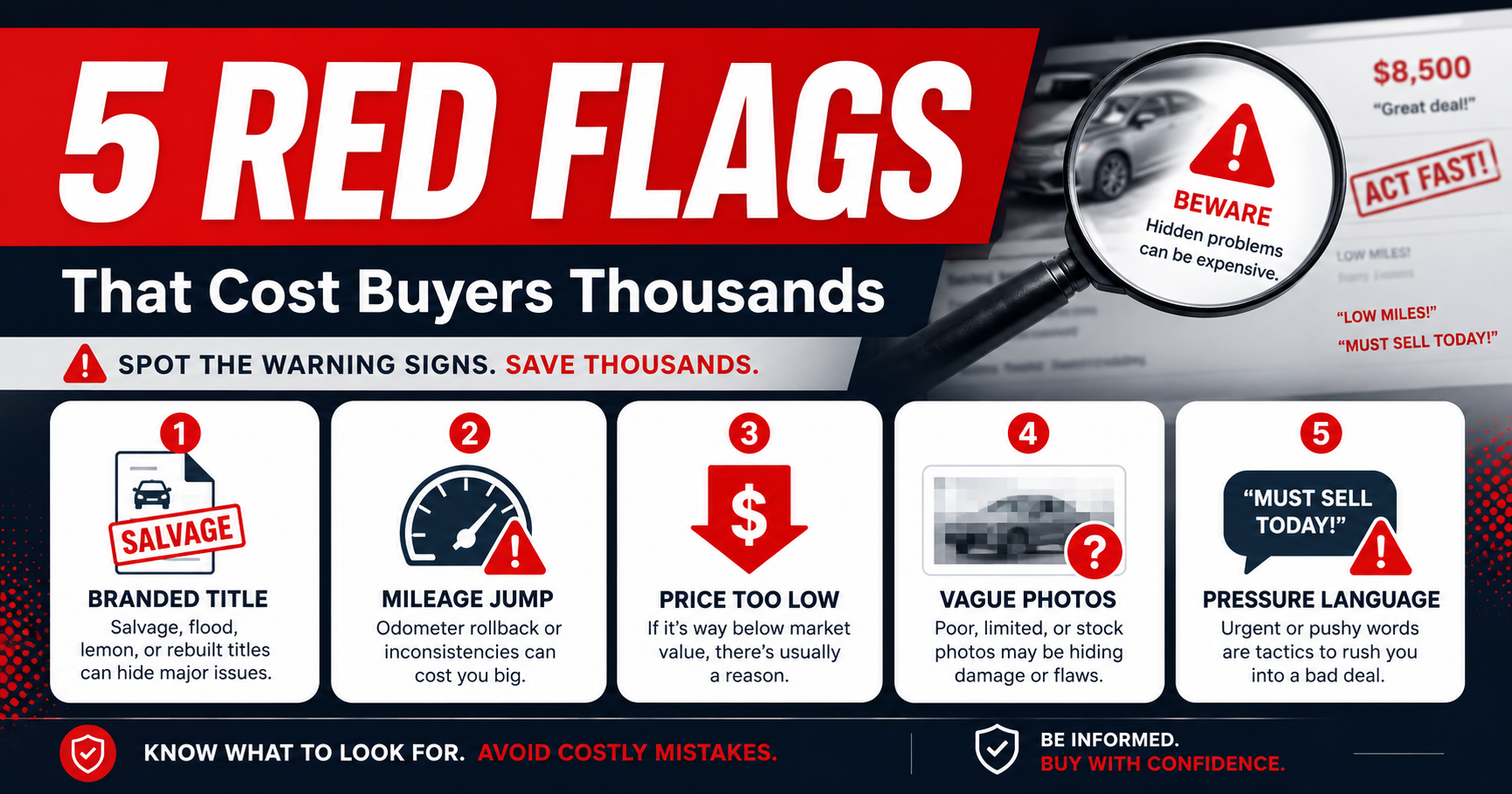
The 5 Red Flags
Apply these five checks to any listing in 5 minutes. You’ll spot 80% of problem cars before wasting time. Use CarClever Lite and this same framework runs automatically.
The Real Cost of Missing a Red Flag
Let’s start with why this matters.
You find a 2019 Honda CR-V priced at $19,500. Market comps are $22,000–24,000. You think you found a deal. You don’t apply these five checks.
Six months later:
- Transmission develops a shimmy (hidden accident damage)
- Transmission service was skipped (you’re now at $4,000 repair)
- Carfax shows “salvage” brand (resale value drops 30%)
- You can’t sell it without disclosing the branded title
Unexpected repairs + depreciation + frustration. This is entirely preventable.
1
Price Doesn’t Match Market Reality
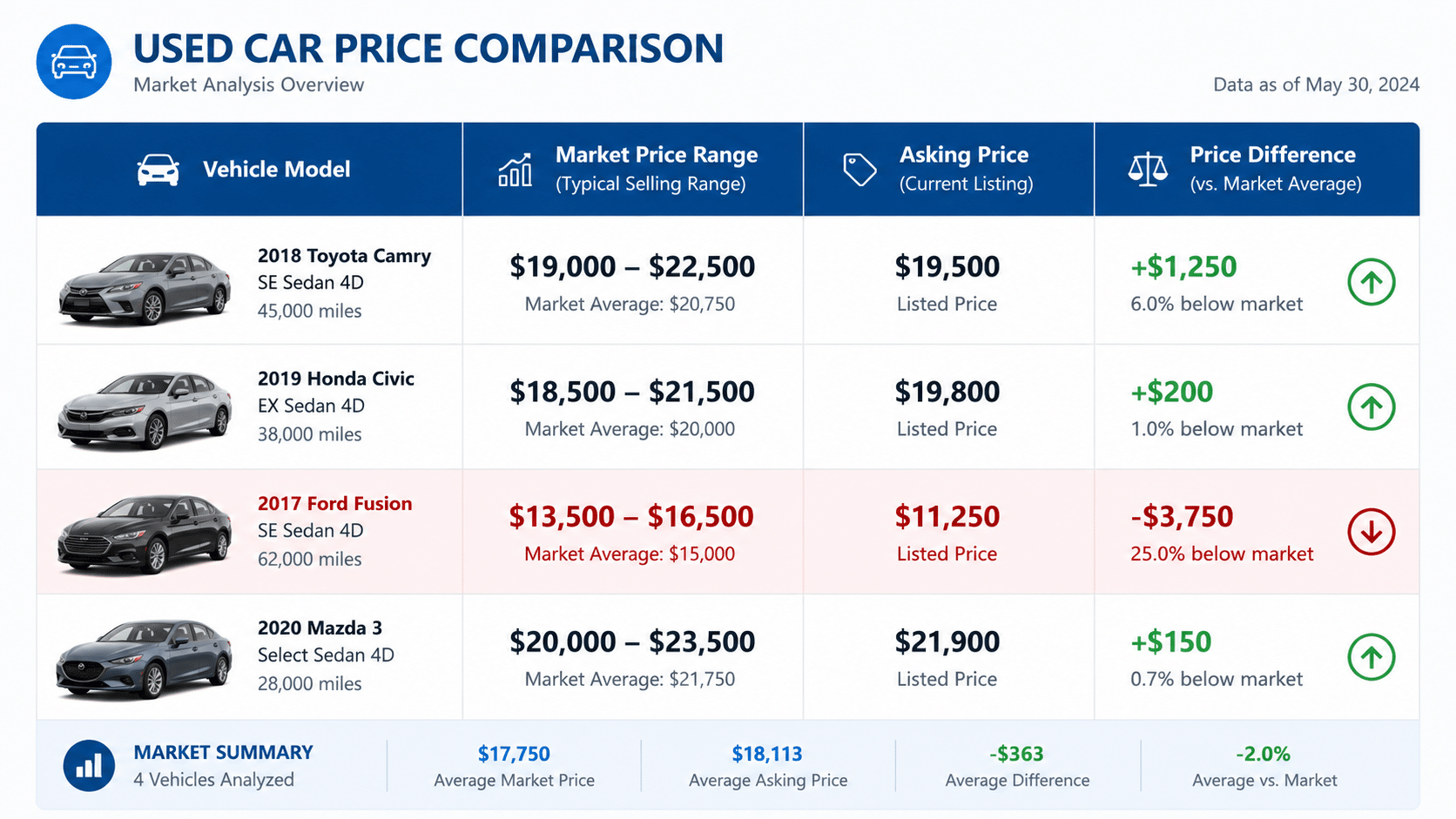
The asking price doesn’t align with what comparable vehicles in your market are actually selling for. Red flag threshold: 15–20% below market = investigate. 30%+ below = walk away or dig deep.
Why This Happens
Legitimate underpricing exists. A motivated seller (job transfer, relocation, emergency) will sometimes price below market.
But 70% of the time, below-market pricing signals a real problem:
| Price Signal | What It Usually Means |
|---|---|
| 15–20% below median | Accident history OR mechanical red flags |
| 30%+ below median | Flood damage OR frame damage OR branded title |
| Accepts lowball offers instantly | Seller knows there’s a problem |
A legal mark on the vehicle’s title indicating past damage, salvage history, or flood damage. Branded titles are permanent and reduce resale value forever. We’ll cover this in Red Flag #5.
How to Spot It
In 5 minutes:
- Search 5–10 comparable vehicles (same year, make, model, trim, mileage)
- Note the price range
- Calculate median price
- Check where this listing sits in that range
Tools: Edmunds, CarGurus, local classifieds, CarClever Lite
“Why is this priced below market?” Good answer: “I’m relocating next week.” Bad answer: “Just priced to move” or evasiveness.
Why It Matters
In the used car market, price is data. Dealers use algorithms to price vehicles. Significant deviation from market = the seller knows something you don’t.
2
The Condition Doesn’t Match the Mileage
A 10-year-old car with 80,000 miles should show normal wear. Pristine condition on high-mileage vehicle = cosmetic repairs masking structural damage.

The Specific Signs
| Red Flag | What It Signals |
|---|---|
| Paint mismatches | Recent body work. Different color panels = accident repair. |
| Pristine interior on 100K+ miles | Either obsessive maintenance (rare) OR water damage hidden with cleaning. |
| Replacement parts that don’t match | Inconsistent maintenance. Newer tires on old car = shortcuts taken. |
| Missing badges or trim | Seller removed to hide damage underneath. |
| New floor mats on old car | Attempting to hide interior stains or water marks. |
How to Investigate
Stand back and look in daylight. This is critical. Paint work is hardest to hide in natural light.
Ask the seller: “Has this car been in an accident?” They’re legally required to disclose major accidents in most states. Get them on record.
Request service records. A car that shows its age is more trustworthy than one that doesn’t.
The Condition-Mileage Framework
| Condition + Mileage | Interpretation |
|---|---|
| Low mileage + pristine | Likely legitimate (garage-kept) |
| Low mileage + worn | Neglect during storage |
| High mileage + pristine | ⚠️ FLAG: Obsessive owner OR cosmetic repairs hiding damage |
| High mileage + worn | Expected, normal wear (honest) |
Why It Matters
Condition tells the history of abuse. If that history doesn’t match the mileage, something’s been hidden. Cosmetic repairs are cheap; structural repairs are expensive.
3
Service History Is Missing or Has Gaps
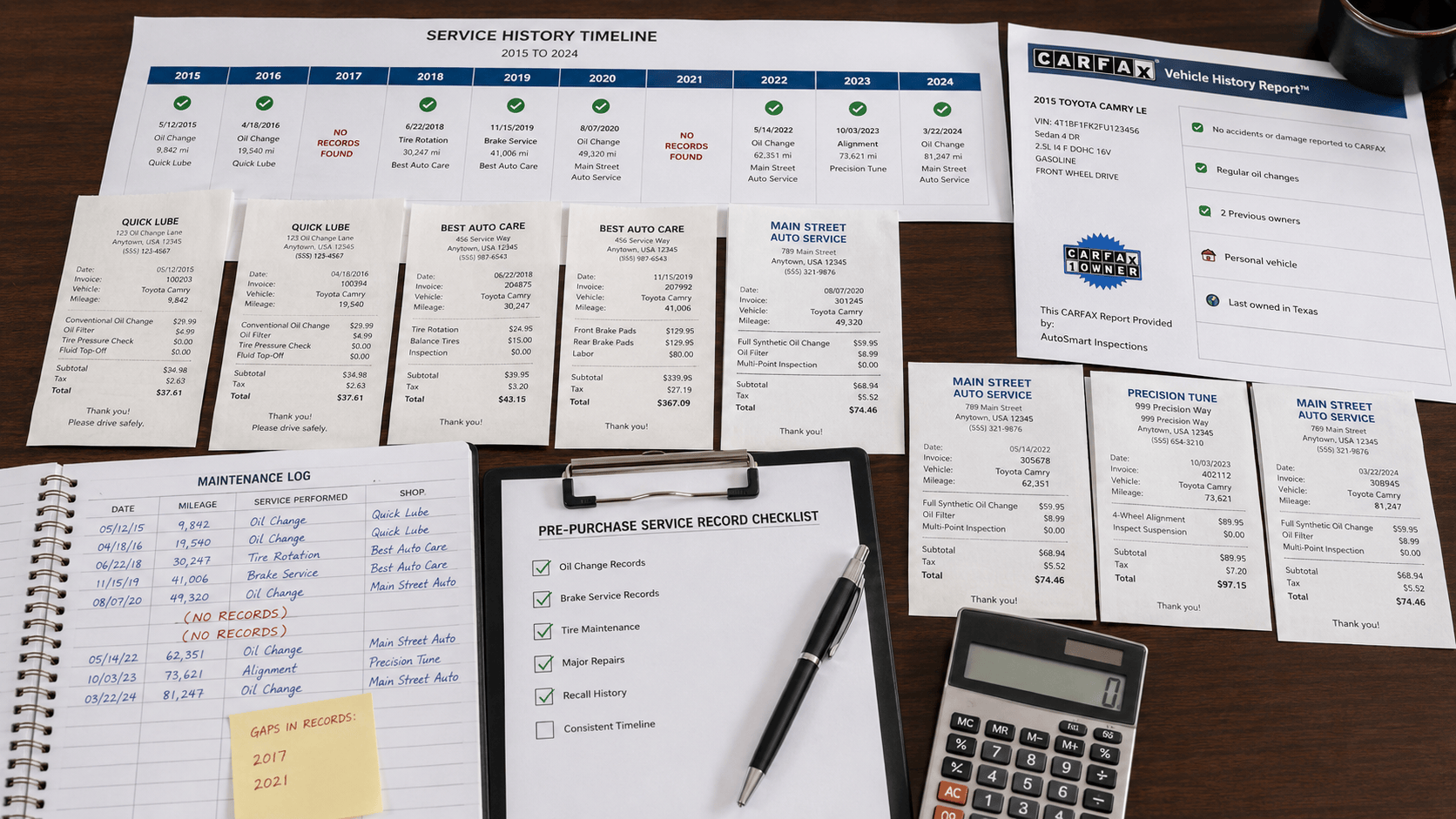
A used car without documented service history is a mystery. You don’t know if critical maintenance was done. Deferred maintenance = $3,000–5,000 repairs waiting to happen.
The Patterns That Signal Problems
| Service History Pattern | Risk Level |
|---|---|
| No records at all | 🔴 HIGH — Walk away unless price reflects this |
| All service at independent shops, zero dealership records | 🟡 MEDIUM — Verify work quality |
| 18+ month gaps between services | 🔴 HIGH — Major maintenance was skipped |
| Routine oil changes only (nothing else) | 🟡 MEDIUM — Expensive services deferred |
| Gaps at high-mileage intervals | 🔴 HIGH — Transmission service skipped at 80K |
How to Investigate
Ask for photos or PDFs of service records. Dealers and shops can provide these.
The Deferred Maintenance Calculator
Understand the cost of what they skipped:
- Transmission fluid service skipped = $1,000–2,000 repair at 120K miles
- Coolant flush skipped = $500–800 when it fails
- Brake fluid service skipped = $400–600 when system corrodes
- Differential service skipped = $500–1,200
For a 100K+ mile car with no service history, assume $2,000–4,000 in deferred maintenance costs.
Why It Matters
Service records prove the previous owner invested in the vehicle’s longevity. Gaps prove they cut corners. Those cuts cost you later.
4
The Seller Seems Evasive or Creates Artificial Pressure
Some sellers pressure you because they’re aware of problems they haven’t disclosed. Trust your instinct.

The Seller Behaviors That Signal Trouble
| Seller Behavior | What It Means |
|---|---|
| Refuses pre-purchase inspection | They know an inspection will reveal problems. Walk away. |
| Creates artificial urgency | “Another buyer coming this weekend” = pressure tactic. |
| Story keeps changing | Single-owner vs three owners? Accident or no? They’re making it up. |
| Gets defensive about questions | You ask something. They get hostile. They’re hiding it. |
| Accepts lowball offers instantly | No negotiation = they want the car gone because they know the problem. |
| Insists on “cash only, no inspections” | Classic move for vehicles with hidden damage. |
The Pressure Tactics to Recognize
“I have another buyer coming” — This is how they rush you into a bad decision.
“I’m only selling this weekend” — Creates false scarcity. There are thousands of cars.
“You seem interested, so I’ll hold it for you” — Then they pressure you to commit before inspection.
“I appreciate that. I need time to inspect with a mechanic. If it passes, we have a deal. If not, I move on.” A legitimate seller respects this. An evasive seller gets annoyed.
Why It Matters
Seller behavior is data. It tells you whether they’re confident in what they’re selling or hoping you won’t dig deeper. If something feels off, it probably is.
5
Title Status Is Branded or Unclear
A branded title is a legal mark on a vehicle’s title indicating past damage or problems. Branded titles are permanent and will haunt you forever.

The Title Brands Explained
| Title Brand | What Happened | Your Risk |
|---|---|---|
| Salvage | Insurance declared it a total loss. | High risk of hidden structural damage. Avoid unless buying for parts. |
| Rebuilt | Salvage car was repaired and passed inspection. | Legally roadworthy but title remains branded. Resale value permanently reduced. |
| Flood | Car was damaged by water. | Electrical gremlins show up months/years later. Rust accelerates. |
| Theft Recovery | Car was stolen and recovered. | May have hidden damage from theft or recovery. |
| Lemon | Had repeated mechanical failures under warranty. | Problematic by definition. Avoid entirely. |
How to Check
Ask the seller directly: “Is this car’s title clean?” If they hesitate, that’s a red flag.
Verify online: Check your state’s DMV database (available online in most states) or order a Carfax report.
The Resale Reality of Branded Titles
This matters because you’ll own this problem:
| Car Status | 2019 Honda CR-V, 72K miles | Resale Impact |
|---|---|---|
| Clean title | ~$22,000 | Baseline value |
| Rebuilt title | ~$15,000–17,000 | −25% loss |
| Flood title | ~$12,000–14,000 | −35% loss |
Title brands follow a car forever. They affect insurance, resale value, and buyer confidence. Don’t inherit someone else’s problem.
Putting It All Together: The Real Scenario
You find a 2019 Honda CR-V EX listed at $19,500 in Denver. Market comps: $21,000–24,000. Apply the framework:
| Check | Finding | Interpretation |
|---|---|---|
| Price | 15–20% below market | Flag raised. Seller explains: “Minor fender-bender three years ago, got fixed.” |
| Condition | Hood and fender have different paint | Confirms accident repair. Seller is honest about it. Not a dealbreaker. |
| Service | Oil change receipts but 18-month gap at 50K | Red flag, but not catastrophic if you get a pre-purchase inspection. |
| Seller | Answers directly, not defensive or evasive | Good sign. They’re not hiding anything. |
| Title | Clean title, Carfax shows disclosed repair | No legal problems. Transparent and verifiable. |
Your next move: Get a pre-purchase inspection from an independent mechanic (~$150–200). If it passes, this might be a reasonable deal—a car with accident history priced accordingly, which is better than a car hiding accident history at full price.
When to Walk Away Immediately
Some red flags mean “investigate further.” Others mean “move on now.”
- The seller refuses a pre-purchase inspection — They’re hiding something.
- The title is salvage or has a lemon brand — Not worth your risk unless you’re a mechanic buying for parts.
- The seller’s story is inconsistent — They’re making things up.
- The price is inexplicably low — Usually a flood car or frame damage, not worth the gamble.
- They insist on “cash only, no inspections” — Classic setup for a problem car.
Remember: There are thousands of cars on the market. If one doesn’t feel right, another will. Your time is worth more than salvaging a bad deal.
From Framework to Automation
You now have a methodology. You can read a listing and identify warning signs in minutes.
But this is tedious for every car. Checking price against comps. Verifying service history. Analyzing seller behavior.
Free to use · No sign-up required · Opens full calculator in new tab
This is where automation changes everything.
CarClever Lite runs this framework automatically on any vehicle you search.
- ✓ Price check: Pulls 50+ comparable vehicles. Shows where this one sits. Instantly.
- ✓ Condition check: Flags title issues and recalls from Carfax data.
- ✓ Service history: Estimates repair reserves based on maintenance patterns.
- ✓ Seller patterns: Flags suspicious pricing that indicates problems.
- ✓ Title status: Shows it directly.
Use @CarClever on ChatGPT
Start Searching with CarClever Lite
Common Questions
A: Not always. A rebuilt title on a 15-year-old car priced accordingly might make sense if you have mechanical knowledge. But for most buyers, the permanent resale hit isn’t worth it.
A: Critical for 100K+ mile vehicles. For newer cars under 100K with a clean Carfax, it’s less critical but still a warning sign if completely absent.
A: Listen carefully. If it’s specific and verifiable, move forward. “I’m relocating” is specific. “Just priced to sell” is vague. The specificity matters.
A: Yes, unless buying from a dealership with a warranty and the car passed their inspection. For private sellers, always.
Leave a Reply