
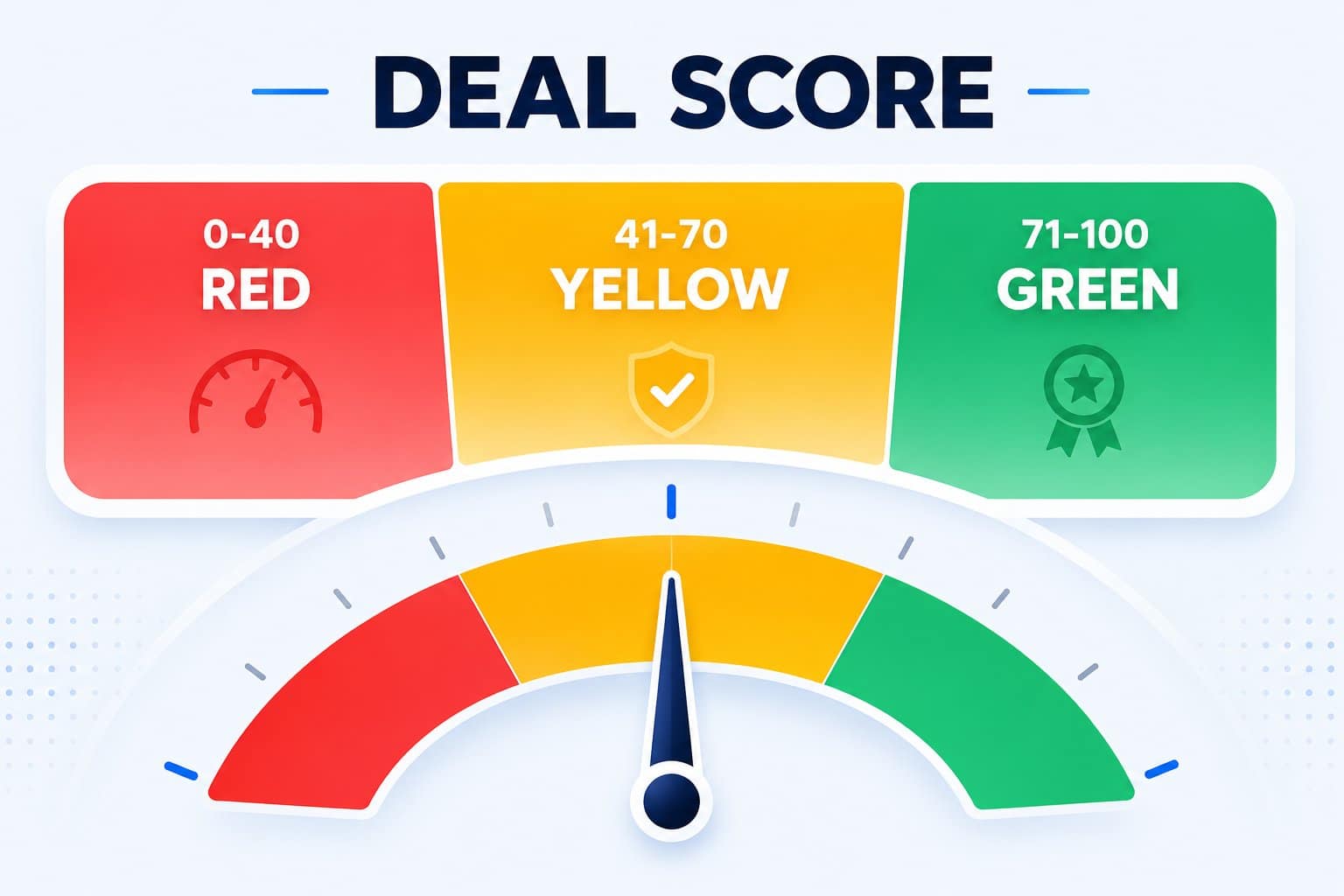
How to read this page: the vehicles, prices, score bands and weights below are simplified, illustrative examples that explain the idea behind the Deal Score. They are not live market data. The exact inputs and bands of the live tool can change, so treat the tool’s own output as the authority for a specific listing, and verify price, condition and history independently.
As built: how the Deal Score Calculator scores a listing. The calculator combines five factors worth up to 20 points each (100 maximum): Market Value (asking price versus the median of at least 15 comparable listings), Mileage (versus an expected 13,500 miles per year), Age (newer scores higher), Reliability (the manufacturer’s track record) and Recall Safety (open NHTSA recalls). Scores of 80–100 are labelled STRONG, 60–79 FAIR, 40–59 CAUTION and 0–39 AVOID. This description was checked against the calculator’s page and code on October 6, 2026; the calculator itself is authoritative if it changes.
The Framework
The Problem: Used Car Pricing Is Broken
You’ve found two nearly identical 2020 Honda CR-Vs. One is $24,500. The other is $29,900. Same mileage, same color, same history. Why the $5,400 difference? And how do you know which is actually the better deal?
Used car pricing is fundamentally opaque. Dealers use emotions, market gaps, and regional inefficiencies to justify wildly different prices for identical vehicles. Buyers have no standardized framework to evaluate whether they’re overpaying.
A transparent algorithm that tells you whether a vehicle is priced fairly in your market—before you negotiate.
The CarClever Deal Score evaluates five factors and returns a single 0-100 number that answers: Is this a good deal?
AVOID, CAUTION, FAIR, STRONG: Understanding the Spectrum
🔴 AVOID / CAUTION (0-59)
Overpriced for market. Walk away or negotiate aggressively.
🟡 FAIR (60-79)
Fair market value. No red flags, but no exceptional value either.
🟢 STRONG (80-100)
Underpriced opportunity. Move fast, but still inspect.
AVOID / CAUTION Zone (0-59): Overpriced
What it means: The vehicle is priced above fair market value for its age and mileage. Dealers often inflate prices to test the market, targeting emotional buyers who don’t do research.

2014 Jeep Cherokee, 150,000 miles, asking $10,500. Market median of comparable listings: $7,491 (23 comparables). Deal Score: 21, AVOID. The price is $3,009 above the median, and the model year has 13 recall campaigns. Walk away, or negotiate far below the asking price.
FAIR Zone (60-79): Fair Market Value
What it means: The vehicle is priced at fair market value. No major red flags, but no exceptional value either. Most vehicles land here.

2023 Honda CR-V, 25,000 miles, asking $27,500. Market median of comparable listings: $31,057 (48 comparables). Deal Score: 73, FAIR. The price is 11% below the median, but the 3 recall campaigns on this model year cost it 15 points. Negotiate on condition and maintenance records.
STRONG Zone (80-100): Underpriced Opportunity
What it means: The vehicle is priced below fair market value for its age and mileage. Listings priced below market can attract more interest, so check the car promptly while still verifying its history and condition.

2022 Toyota Camry, 30,000 miles, asking $19,900. Market median of comparable listings: $27,713 (39 comparables). Deal Score: 91, STRONG. The price is $7,813 below the median. Move to inspection quickly, and check the vehicle history report first.
What Goes Into the Deal Score? The 5 Factors
The Deal Score evaluates five factors. Here’s how each one influences the score:
1. Vehicle Age
Why it matters: Older vehicles cost less but depreciate faster. Age compounds with mileage to determine realistic value.
How it works: The algorithm compares the vehicle’s age to market comps. A newer vehicle of the same make/model at the same price will score higher.
2. Mileage
Why it matters: Mileage = wear. 30K miles vs. 80K miles means different maintenance costs ahead.
How it works: The calculator compares mileage with an expected 13,500 miles per year for the vehicle’s age. Higher-than-expected mileage lowers the score.
3. Market Value (Comparable Listings)
Why it matters: Is the asking price above, below, or at fair market rate? Price versus the market is one of the five equally weighted factors.
How it works: The calculator compares the asking price with the median price of comparable listings. It looks for at least 30; if fewer are found nearby, it widens the search radius, then the year range, and finally drops the trim level.
4. Reliability Rating
Why it matters: Some makes break down more often than others. Higher reliability = lower future maintenance costs = higher deal value.
How it works: The calculator scores reliability based on the manufacturer’s track record. Makes with a stronger record receive higher scores and makes with a weaker record receive lower scores.
5. Recall Safety
Why it matters: Open safety recalls are unrepaired safety defects. A vehicle with open recalls carries more risk until the repairs are completed.
How it works: The calculator counts the vehicle’s open NHTSA recalls; more open recalls lower the score.
Reading a “Good Deal” Label From Any Used-Car Site
Some links on this page are affiliate links. If you use one, GetCarWise may receive compensation at no additional cost to you. Our recommendations remain independent.
How should I read a “good deal” label from a used-car site?
Read it as that provider’s price estimate, based on its own data and rules. TrueCar says its used-car Price Rating compares recent listing prices for similar vehicles in the shopper’s area, while CarGurus says its IMV and Deal Ratings use all-in prices including disclosed fees. Those systems use different methods, so compare their evidence rather than treating the labels as interchangeable. TrueCar Price Rating FAQ; CarGurus fee-transparency update. For a side-by-side of the main tools, see our guide to the best AI tools for buying a used car.
The Deal Score is GetCarWise’s own tool, not a universal marketplace label. Use the Deal Score page to evaluate an asking price, then inspect the assumptions and comparable vehicles available for that car. A score can help organize a price check; it does not establish the vehicle’s mechanical condition or guarantee that a seller will accept the indicated price.
Why can two sites rate the same car differently?
Sites can compare different listings, locations, vehicle details, and fees. A price signal may also be incomplete when the listing lacks information needed by that provider. A difference between ratings is a reason to inspect the underlying comparison and ask the seller for the complete price, not a reason to assume one site is correct.
What should I match before comparing two asking prices?
Match the details that change what the vehicle is worth: model year, make and model, trim, mileage, condition, equipment, location, title and warranty status, and the fees included in the price. If the vehicles differ on one of these points, note the difference instead of treating their asking prices as equivalent.
The CFPB explains that vehicle price includes more than the base price: options, add-ons, fees, and financing can affect the total paid. TrueCar also identifies mileage, location, options, and condition as factors in its used-car rating. Use listing details to build a fair comparison, then request the seller’s written out-the-door price. CFPB: What factors into the price of a car?; TrueCar used-car listings.
Does a strong price rating mean the car is a good one to buy?
No. A price rating answers a pricing question according to the provider’s method. It does not confirm the title, service history, warranty, or mechanical condition of the particular car. The FTC recommends getting a vehicle history report and an independent mechanic’s inspection; its guidance says a history report is not a substitute for that inspection. FTC: Buying a Used Car From a Dealer.
Use the Deal Score as one price-screening input. Then verify the VIN and documents, review the seller’s written price and warranty terms, and inspect the car. If you need listings to compare, you can browse used car listings on Edmunds.
Ready to compare similar cars?
Frequently Asked Questions
Not necessarily. A green score with high mileage usually means the vehicle is significantly underpriced. What matters is the service history. If the 95K-mile vehicle has complete service records, it’s an opportunity. If it has no records, that’s the trap. Deal Score tells you if it’s priced right; your inspection tells you if it’s mechanically sound.
The Deal Score is based on market data, not a vehicle’s actual condition. An AVOID-scored vehicle might have just had a $3K engine repair (not yet in the data). A STRONG-scored vehicle might have hidden frame damage. The score tells you if pricing is fair; your inspection tells you if the vehicle is safe. Always get a pre-purchase inspection, regardless of score.
Not directly. The algorithm uses comparable data, which may reflect accident history in aggregate pricing. But specific accidents are found through a title search and vehicle history report (the Vehicle History section on the Edmunds dealer listing, or AutoCheck). Use Deal Score to identify fairly-priced vehicles, then cross-reference with title/history reports to find hidden problems.
No. FAIR means fair market value. It means you’re not overpaying, but you’re also not getting exceptional value. FAIR is the ‘normal’ market. STRONG is the exception. Aim for STRONG if you can find it, but FAIR is a solid choice.
Market data updates daily as new listings hit the market. Vehicle-specific factors are current as of the listing date. We recommend checking scores weekly as you shortlist vehicles—prices and market conditions shift constantly.
The Framework: Remember AVOID, CAUTION, FAIR, STRONG
The Deal Score is a simple framework: AVOID / CAUTION (0-59) = avoid, FAIR (60-79) = fair value, STRONG (80-100) = opportunity. It combines five transparent factors—age, mileage, market value, reliability, recall safety—to tell you if a vehicle is priced fairly.
It’s not a guarantee of quality (that requires inspection), but it’s a powerful tool for filtering overpriced listings and identifying genuine deals.
Armed with this framework, you can walk into a negotiation knowing whether the asking price is fair—and exactly how to negotiate if it isn’t.
Ready to See Deal Scores on Real Vehicles?
CarClever Lite calculates Deal Scores automatically for any vehicle you search. Search any car in your area and see how it stacks up against the market.
Use CarClever – Buying Assistant
Search car listings and compare vehicles in the AI app you use. Check any VIN for details and recalls.
Prefer the web?
Open CarClever LiteCarClever – Buying Assistant. Search a daily-updated catalogue of U.S. new and used listings, compare your shortlist and check a VIN.
Leave a Reply